
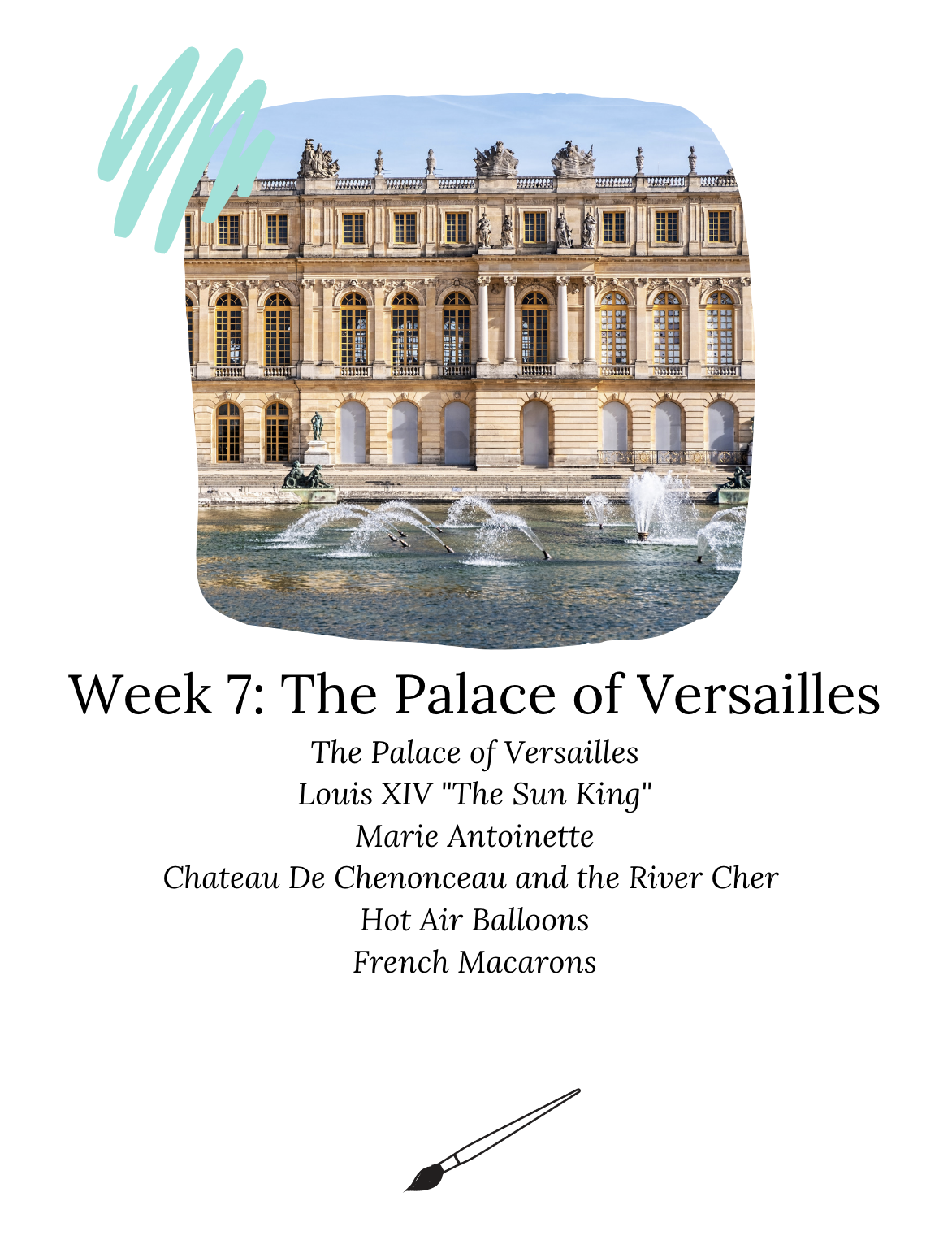
Supplies for France Week 7:
Books:
About Hot Air Balloons:
Hot Air: The (Mostly) True Story of the First Hot-Air Balloon Ride by Marjorie Priceman
Miranda the Explorer: A Magical Round-the-World Adventure by James Mayhew
The Noon Day Balloon by Margaret Wise Brown, Illustrated by Lorena Alvarez
Dreams Come True All They Need is You! by Mike Dooley
Rosie Revere, Engineer by Andrea Beaty
The Chipmunk Adventure by Ross Bagdasarian Jr
Books About Versailles:
Versailles: A Private Invitation Hardcover by Guillaume Picon
Versailles: Discover This Children's Versailles History Book (Kindle) by Bold Kids
Versailles: A Private Invitation by Francis Hammond (Phot
Versailles: The History and Legacy of France's Most Famous Royal Palace Audible Audiobook – Unabridged by Charles River Editors
Palace of Versailles: Home to the Kings of France by Jennifer Howse
Marie Antoinette, princess of Versailles by Kathryn Lasky
Moi and Marie Antoinette by Lynn Cullen
Who Was Marie Antoinette? by Dana Meachen Rau
The World of William Penn by Genevieve Foster page 82
Books to learn more about the French Revolution and Marie Antoinette:
Marie Antoinette, Princess of Versailles by Kathryn Lasky
Moi and Marie Antoinette by Lynn Cullen
Who Was Marie Antoinette? by Dana Meachen Rau
Who Was Napoleon? by Jim Gigliotti
Who Were the Jacobins? French Revolution History Book for Kids Children's European History by Baby Professor
Understanding the French Revolution: Pocket History for Kids by George Joshua
History in a Hurry: French Revolution by John Farman
The French Revolution: Terror and Triumph by Heather E. Schwartz
The French Revolution Explained for Kids: The English Reading Tree by Keith Goodman
Books to learn about Louis XIV:
The King's Day: Louis XIV of France by Aliki
The Story of the World Volume 3: Early Modern Times by Susan Wise Bauer (page 143)
The World of William Penn by Genevieve Foster (pg 74)
Children's Novels set during the time of the French Revolution:
In the Reign of Terror: A Story of the French Revolution by G. A. Henty
A Tale of Two Cities by Charles Dickens
Art Supplies:
Any of your favorite art supplies, watercolor, markers, etc.
In the Kitchen:
whipping cream
whole milk
bittersweet chocolate
eggs
white sugar
vanilla extract
whipping cream
powdered sugar
Videos to learn about the topics included in this weeks adventure:
Palace of Versailles
The Magnificence of the Palace of Versailles
Located in the outskirts of Paris, France, the Palace of Versailles stands as an extraordinary testament to absolute power and opulence. This grand architectural marvel, built in the 17th century, boasts stunning Baroque and Rococo designs that mesmerize visitors from all corners of the world. With its sprawling gardens and extravagant interiors, the palace epitomizes the lavish lifestyle of the French monarchy, particularly during the reign of Louis XIV, the Sun King. From the glittering Hall of Mirrors to the ornately decorated chambers, every inch of Versailles oozes elegance and sophistication. The sheer scale and attention to detail in its construction serve as a reminder of a bygone era, transporting admirers back in time to witness the grandeur of the royal court. Visiting the Palace of Versailles is a truly immersive experience that leaves one in awe of its historical significance and artistic mastery.
History of the Palace of Versailles:
The Hall of Mirrors:
The Hall of Mirrors is a famous room located in the Palace of Versailles in France. It was built in the 17th century during the reign of King Louis XIV as part of a major expansion of the palace. The hall is known for its grandeur and opulence, featuring 17 large mirrors on one side and 17 windows on the other, reflecting the light and creating a stunning visual effect. It was used for many important events, including the signing of the Treaty of Versailles in 1919. Today, it is a popular tourist attraction and a symbol of the French monarchy's power and prestige.
Watch this clip of a reenactment of King Louis showing his Hall of Mirrors to his friends from a tv show:
The Gardens of Versailles:
Marie-Antoinette
Hot Air Balloons
In 1783, an experiment with a hot air balloon was conducted at the Palace of Versailles in France. This experiment marked the first successful flight of a human-made aircraft. The balloon was designed by the Montgolfier brothers, who used hot air to make the balloon rise. The first passengers were a rooster, a duck, and a sheep, who were sent up to test the effects of air travel on living creatures. Later, on September 19th, 1783, the first human passengers, a scientist named Pilatre de Rozier and a French army officer named Marquis Francois d'Arlandes, flew in the balloon for almost 25 minutes, covering a distance of about 5 miles. This experiment paved the way for further advancements in aviation technology.
Let’s learn about how hot air balloons work, then create your own Art inspire by Hot Air Balloons!
Additional hot air balloon craft ideas:
Chateau De Chenonceau on the River Cher
Learn about what makes French Gardens so special, with the video below with Don Monty.
The first tour is Chateau De Chenonceau. Its history is very interesting and one of the first gardens in France. Compare this older garden with Versailles.
Which one do you like the most?
RECIPE: Enjoy our Macarons recipe in our Adventure this week, and enjoy these lovely videos for those visual learners!
History of French Macarons:
Macarons have a rich history that spans from Italy to France, tracing back centuries. Although the exact origin of macarons is debatable, it is widely believed that they were first created in Italy during the Renaissance period. Originally known as "maccheroni," these early macarons were made with almond flour, sugar, and egg whites. It was not until the 16th century that Catherine de' Medici brought the recipe to France when she married King Henry II. The macarons gained popularity in the French royal court, becoming an exquisite delicacy enjoyed by the nobility.
However, it wasn't until the 19th century when macarons gained popularity and recognition by Pierre Desfontaines, who sandwiched two almond meringue cookies together with a creamy filling. Since then, macarons have become synonymous with Parisian patisserie. Today, these dainty treats come in a multitude of flavors and colors, each bite encapsulating the perfect balance of crispness and chewiness. The French macaron has truly become an iconic symbol of French craftsmanship and culinary excellence.
The Journey of Almonds for French Macarons in the Renaissance Period
In the thriving culinary landscapes of the Renaissance period, the origin of the almonds used in French macarons offered a glimpse into the global trade routes of this flourishing era. These delicate, melt-in-your-mouth confections, adored by nobles and connoisseurs alike, owed their existence to a magnificent journey. Harvested from the warm Mediterranean regions, almonds embarked on a voyage across vast seas, bringing their vibrant flavors and versatile textures to the palaces and courts of France. Vessels laden with sacks of this prized nut traversed through bustling trading ports such as Venice, Genoa, and Marseilles. They navigated challenges and triumphs, every wave and gust of wind carried their precious cargo closer to the opulent estates, where skilled patissiers would transform them into exquisite French macarons, enchanting all who indulged in their almond-infused splendor.
Watch this video to gain some great tips and tricks on making French Macarons from a French Chef!
Yay! You have completed Week 7 of Level 2: Adventures in France with the Build Your Masterpiece Class! Great Job! Please tag us @build your masterpiece class on Instagram with all your beautiful masterpieces! Tell me what you enjoyed learning about from this week’s unit study!
Plus, Get ready for Week 8! It’s coming soon!
Shop our curriiculum from our new SHOP.THEMASTERPIECESTUDIO.COM